
The Right of Way in Branding
What a Traffic Standoff Can Teach Us All About Brand Strategy for Small Business
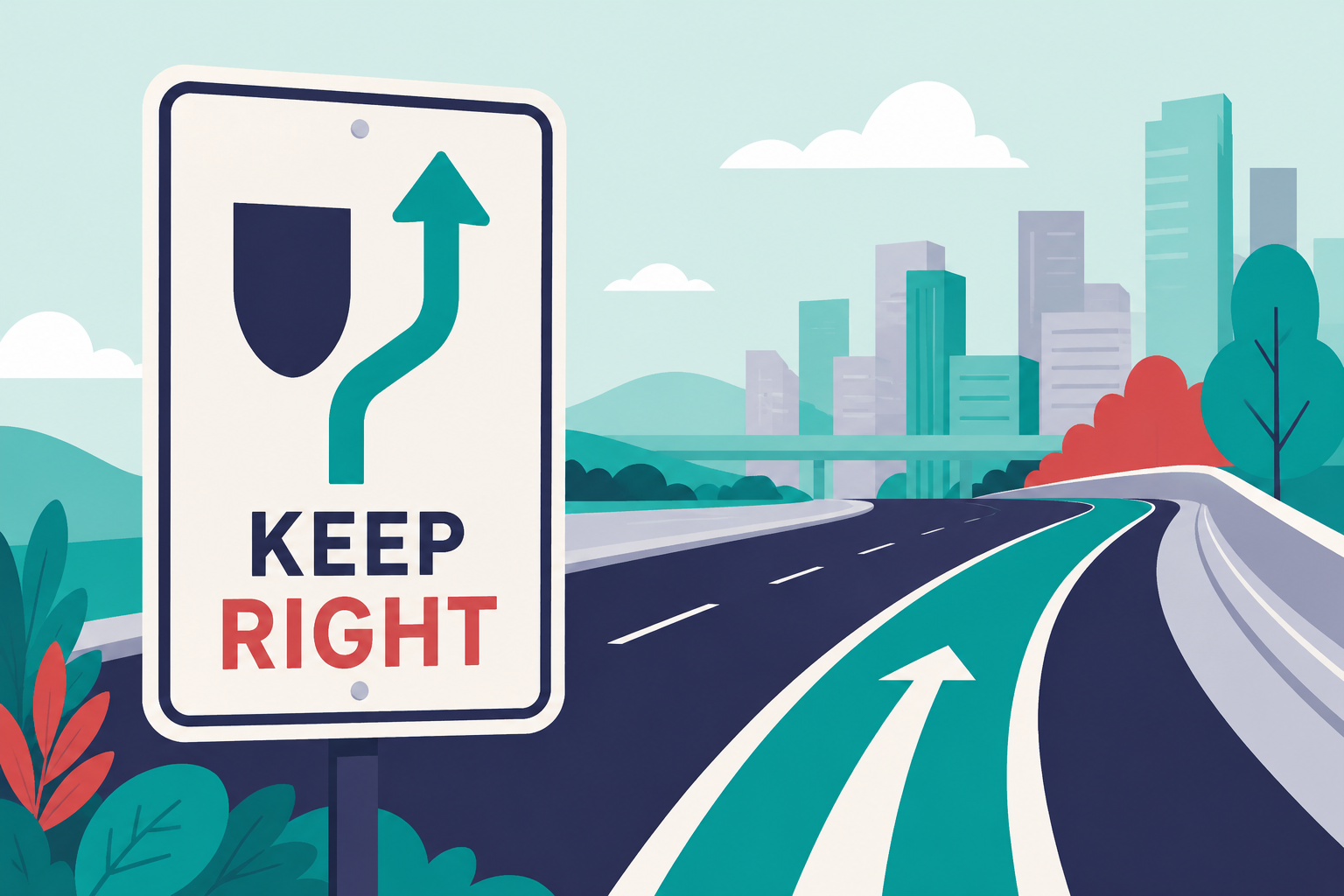
There are small moments in life that stop you in your tracks — not because they're dramatic, but because something in them rings just a little too true.
This was one of those mornings.
Five days of rain had finally broken. The kind of grey stretch that parks itself over your week and refuses to leave — the sort where the air smells like wet concrete and every walk to the car feels like a minor inconvenience. But today? Today, the sky had made up its mind. Clear. Bright. The kind of morning that makes you feel like you've earned something.
I'd made a commitment — and I want to stress that word, commitment — to step away from my desk. There's always another strategy to map, another brand story to untangle, another load of laundry to put in. But a dear friend had been waiting on that coffee, and I'd decided this morning was going to be different. Intentional. Unhurried.
I had it timed perfectly.
I know the rhythm of my neighborhood the way a conductor knows a score. The traffic light at the end of my street holds for exactly long enough. Turn left, merge, and you're in the clear before the wave of traffic rolls through. It's a ten-second window — a small, beautiful, predictable pocket of order in an otherwise chaotic world.
I pulled to the end of my street, flicked on my signal, and glanced right.
A car was approaching the turn lane — the lane designated, by every law of the road, for her to turn into my neighborhood. No oncoming traffic. Clear skies. A wide open path. All she had to do was complete her turn. Simple. Textbook. Predictable.
And then she stopped.
She stopped — and was presumably waving me out. Maybe, I'm not sure; the sun was beating into my eyes. But I'm guessing that's what she was doing.
Now, I want to be fair here. I know what she was doing. She was being kind. She saw someone waiting and thought, "I'll let them go first." It came from a good place. It really did. But the road doesn't run on good intentions — it runs on agreed-upon rules. And in that moment, her generous impulse created something neither of us wanted: a standoff.
There I sat, sun blazing straight into my eyes, squinting at her heavily tinted windows, trying to read a wave I wasn't even sure was happening.
Was she waving me out? Was she just sitting there? I couldn't tell.
So I waited. She waited. We both waited. Two people with somewhere to be, frozen in a wordless negotiation that neither of us had signed up for.
What should have been a six-second exchange turned into nearly 15 seconds of mutual uncertainty — and I missed my window entirely.
By the time she finally made her turn — with such sudden urgency that I half-expected her to clip my bumper — the light had changed. Traffic was released from both directions. My perfect little pocket of order had closed, and I was now sitting there watching it pass, calculating how late I was going to be.
Almost eight minutes, as it turned out.
All because someone tried to do me a favor outside of her lane.
I've thought about that moment more than I probably should. But it stayed with me because it is such a clean picture of what I watch happen to brands every single day.
Not the collaboration part — though there's a version of this story about that too. The strategy part. The part where someone skips the rules of the road entirely and expects the intersection to sort itself out.
Here's what I mean.
Most business owners I talk to don't come to me because they have no ideas. They come to me drowning in them. They know their audience. They know their mission. They've got a color they love, a competitor they admire, a tagline they scribbled on a napkin at 2 AM. What they don't have is a system for deciding which of those ideas gets the right of way.
And without that system — without strategy — their brand becomes that intersection. Every design choice, every color, every word on the website is just another car sitting at the stop sign, waiting for someone to wave it through. The logo says one thing. The website copy says another. The Instagram grid is doing its own thing entirely. The brand identity is scattered across touchpoints instead of moving in one clear direction. Nobody's moving because nobody agreed on who goes first.
Brand strategy is the right of way.
It's the set of agreed-upon rules that tells every decision — not just the visual ones — where it belongs, when it moves, and why.
And it starts long before anyone opens a design tool.
It starts with positioning: who are you for, and why should they choose you over every other option? It starts with messaging: what do you actually say to the person standing in front of you who has a problem you can solve — and how do you say it so they feel it in their gut, not just their head? It starts with voice: are you the calm authority in the room, or the sharp, no-nonsense friend who tells it like it is? It starts with knowing your client so specifically that you could describe their Tuesday morning frustrations back to them before they've said a word.
That's the foundation. That's the right of way. And it's what separates the brands that attract premium clients — the ones who arrive pre-sold, already convinced you're the right fit — from the ones still explaining themselves on every discovery call.
Not your logo.
Not your color palette.
Not your font.
Those come later — and when the strategy is solid, they almost choose themselves.
When strategy leads, you stop debating and start building. The website copy lands because the messaging was nailed down first. The social media feels like one voice — consistent across every platform — not because someone made a template, but because there's a positioning document underneath it that everyone's drawing from. The sales conversation gets easier because you're not improvising your value — you've already articulated it in language your ideal client recognizes as their own.
When strategy doesn't lead? You get the standoff. You get a business owner sitting across from a designer, unable to give feedback on a homepage, because no one ever defined what that homepage needed to say or to whom. You get a founder rewriting their Instagram bio for the ninth time because they still can't answer "what do you do?" in a way that makes the right person lean in. You get a brand that sounds different on every platform because there was never a voice to begin with — just vibes.
The woman in the turn lane wasn't wrong to be kind. But kindness without clarity created chaos. In the same way, good taste, strong opinions, and genuine passion for your business aren't wrong. But without a strategic framework underneath them, they create exactly the same thing: two people waving at each other through tinted glass, each waiting for the other to go first, while the window quietly closes.
I got to that coffee eventually. Eight minutes late, a little sun-squinted, and carrying a story I knew I'd tell for a long time.
Because sometimes the most useful lessons arrive in the most ordinary moments. At the end of a street, in the space between two cars that each meant well, and in the pause before someone finally decides to just take their turn.
Brand strategy is how your brand takes its turn. It's how every piece of your identity knows where to go without hesitation, without second-guessing, without a 15-second standoff over what to say, who to say it to, or how to sound when you say it.
And that — the confidence, the clarity, the momentum — is what I build for my clients. Not pretty things. Not trendy things. A system of decisions that makes the pretty things mean something.
That's what brand strategy does for a small business: it stops the guessing, names the direction, and gives every piece of your brand a lane.
If you're a coach, a founder, or a service-based entrepreneur who's outgrown the brand that got you started — and your brand feels like that intersection, lots of good pieces and not enough direction — that's exactly where my Core 2 Clarity Brand Map starts. We dig deep into the "why" so every visual, every word, and every decision that follows has a lane to be in.
Know your lane. Trust the process. Take your turn.
If you’re ready to exit the round-about and get on the right strategic direction with your brand, book a quick call with me and let’s chat.
